Pages

Wednesday, June 5, 2019

ABP 2019 - Part II: First news from Lake Baikal


Swinhoe´s Rail at Lake Baikal - likely the westernmost record of this secretive species (Marc Bastardot)

After two days of travelling by train through mountains covered with pink Rhododendron flowers,
we arrived at the Selenga river on the 27thof May. The next morning we went by boat into the vast river delta, to work with Yury Anisimov and Valentina Anisimova in the Kabansky nature reserve. We were looking for returning Yellow-breasted Buntings Emberiza aureola and Siberian Rubythroats Luscinia calliope. But during the first days we caught mainly lots of migrants – the bushes were filled with Brown Shrikes Lanius cristatus, Arctic Warblers Phylloscopus borealis and Taiga Flycatchers Ficedula albicilla. But we also stumbled across a really rare bird: while brushing my teeth outside one late night, I heard a faint “purr” which immediately reminded me of the song of the Swinhoe´s Rail Coturnicops exquisitus, which we had only recently discovered at Muraviovka Park (see publications here and here). Being far off the known breeding range, I did not trust myself, but I told Yury, Valentina and Marc who were still awake. Marc immediately got on fire and trapped the very bird within less than an hour using the same technique as Tom Wulf in the Amur region. What a sensation! To my knowledge, this is the westernmost record of this species, and the habitat in the large river delta looks similar to its breeding sites in the Russian Far East. The next nights will hopefully proof if this bird was a lonely vagrant, or if we just discovered another unknown breeding area of this enigmatic species. Good news also from the buntings: at the end of the week, we found at least one returned bird. The team will stay for two more weeks in the delta, and I hope they will recapture some of the returning individuals from last year. Meanwhile, I am on my way to Mirnoye, to see how many of the Rubythroats at the Yenisei river will return with their geolocator.
Zwei Tage lang fuhren wir mit dem Zug durch rosa-blühende Berge voller Rhododendron, bevor wir am 27. Mai am Fluss Selenga ankamen. Am nächsten Morgen ging es mit dem Boot in das schier endlose Delta, wo wir mit Yury Anisimov und Valentina Anisimova im Kabansky Schutzgebiet arbeiten. Uns interessiert hier vor allem, ob einige der im Vorjahr markierten Rubinkehlchen und Weidenammern zurückgekehrt sind. Aber in den ersten Tagen fingen wir vor allem zahlreiche Zugvögel – die Büsche waren voll mit Braunwürgern, Wanderlaubsängern und Taigaschnäppern. Aber wir stolperten auch über einen ganz besonderen Vogel. Als ich eines späten Abends meine Zähne draußen putzte, hörte ich aus der Ferne ein vertrautes „pürr“, was mich sofort an das Mandschurensumpfhuhn denken ließ. Den Gesang dieser Art hatten wir erst kürzlich im Muraviovka Park entdeckt (siehe Publikationen hier und hier). Da wir uns aber weit entfernt des bekannten Brutgebietes befanden traute ich meinen Ohren nicht, berichtete aber Yury, Valentina und Marc von der Beobachtung, die als einzige noch wach waren. Marc war sofort Feuer und Flamme, und innerhalb kürzester Zeit hatte er eben jenen Vogel mit der von Tom Wulf am Amur entwickelten Technik gefangen. Was für eine Sensation! Soweit ich weiß, dürfte es sich damit um den westlichsten Nachweis dieser seltenen Art handeln, und das Habitat im Selenga-Delta ähnelt durchaus dem Brutgebiet im fernen Osten. Die nächsten Nächte werden nun hoffentlich zeigen, ob es sich dabei um einen einsamen Irrgast handelte, ober ob wir die nächste bisher unbekannte Population dieser kaum erforschten Ralle entdeckt haben. Gute Nachrichten gab es am Ende der Woche auch von den Ammern: mindestens eine der Weidenammern vom letzten Jahr ist zurück in ihrem Revier. Das Team wird noch zwei Wochen Zeit haben, und hoffentlich einige Individuen vom letzten Jahr fangen können. Währenddessen bin ich nun schon auf dem Weg nach Mirnoye, um auch dort zu schauen, wie viele Rubinkehlchen ihren Geolokator wieder mitgebracht haben. 

// Wieland

Shopping for three weeks in the field (Ilka Beermann)

Yury Anisimov with a Yellow-breasted Bunting (Friederike Kunz)

Late migrant: Little Bunting (Ilka Beermann)

Nice bycatch: Swinhoes Robin (Ilka Beermann)

Our new Russian "tourist seats" (Leo Damrow)

A net full of wagtails (Ilka Beermann)

Group picture with the rangers (Ilka Beermann)
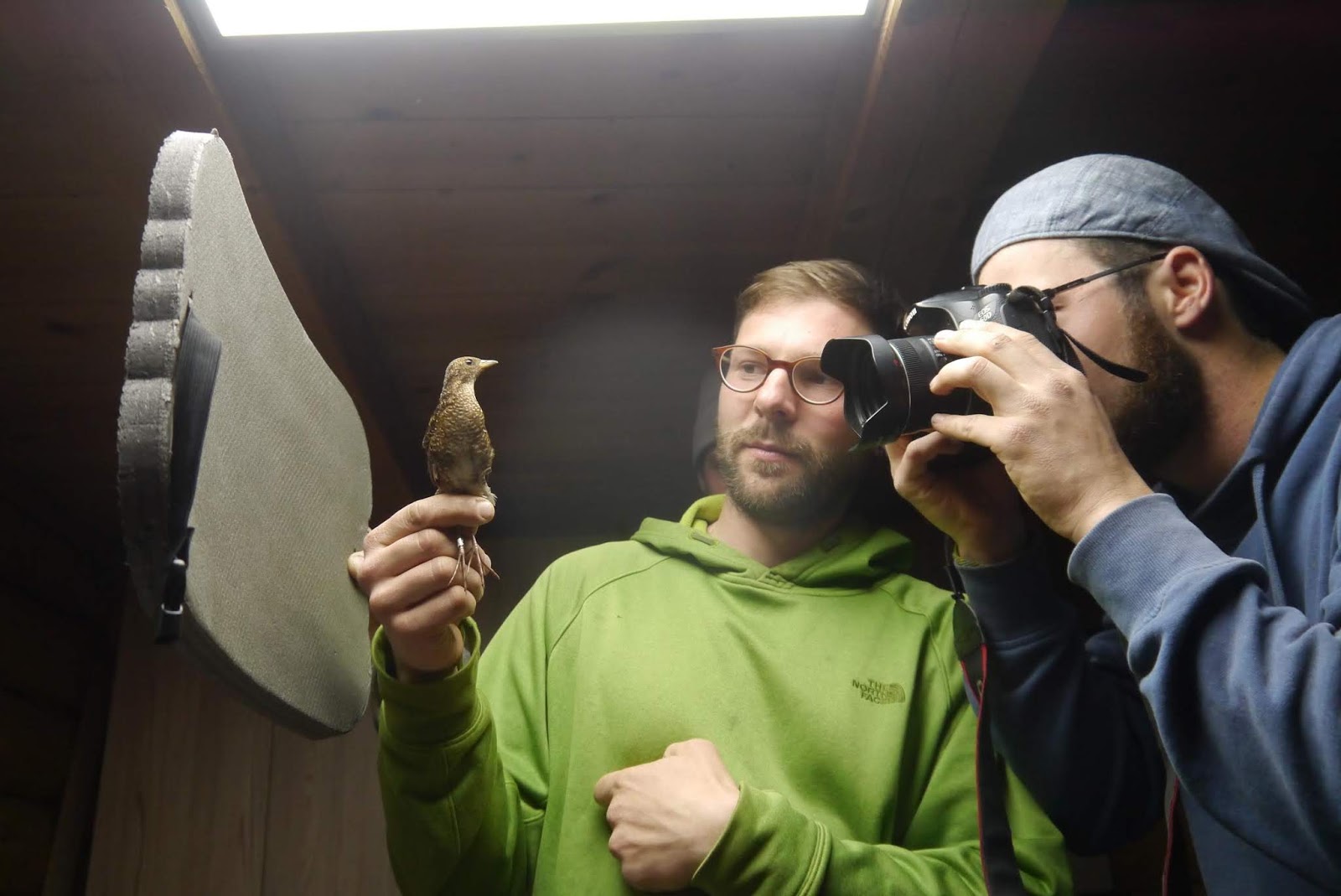
Taking pictures of the Swinhoe´s Rail (Ilka Beermann)

Total traps, 28.05.-02.06.2019: 131 birds out of 20 species
RubinkehlchenSiberian RubythroatСоловей-красношейкаLuscinia calliope22
RauchschwalbeBarn SwallowДеревенская ласточкаHirundo rustica19
DunkellaubsängerDusky WarblerБурая пеночкаPhylloscopus fuscatus18
BachstelzeWhite WagtailБелая трясогузкаMotacilla alba10
TaigaschnäpperTaiga FlycatcherВосточная малая мухоловкаFicedula albicilla8
MaskenammerBlack-faced BuntingСедоголовая овсянка Emberiza spodocephala8
KlappergrasmückeLesser WhitethroatСлавка-завирушкаSylvia curruca7
BlaunachtigallSiberian Blue RobinСиний соловейLuscinia cyane6
Gelbbrauen-LaubsängerYellow-browed WarblerПеночка-зарничкаPhylloscopus inornatus5
MeisengimpelLong-tailed RosefinchУрагусUragus sibiricus5
RohrammerReed BuntingКамышовая овсянкаEmberiza schoeniclus5
ZitronenstelzeCitrine WagtailЖелтоголовая трясогузкаMotacilla citreola5
WeidenammerYellow-breasted BuntingДубровникEmberiza aureola4
SchwanzmeiseLong-tailed TitОполовникAegithalos caudatus2
BraunwürgerBrown ShrikeСибирский жуланLanius cristatus2
WanderlaubsängerArctic WarblerПеночка-таловкаPhylloscopus borealis1
Dickschnabel-RohrsängerThick-billed WarblerТолстоклювая камышевкаAcrocephalus aedon1
MandschurensumpfhuhnSwinhoe´s RailБелокрылый погонышCoturnicops exquisitus1
SchwirrnachtigallRufous-tailed RobinСоловей-свистунLuscinia sibilans1
ZwergammerLittle BuntingОвсянка-крошкаEmberiza pusilla1

Tuesday, May 28, 2019

New publication: Tracing the origins of Siberian vagrants in Europe

Yellow-browed Warblers occur in increasing numbers in Europe, but their origin remains unknown © Arend Heim

De Jong A, Torniainen J, Bourski OV, Heim W, Edenius L (2019) Tracing the origin of vagrant Siberian songbirdswith stable isotopes: the case of Yellow-browed Warbler (Abrornis inornatus) in Fennoscandia. Ornis Fennica 96

Vagrant birds are mesmerizing birdwatchers worldwide, but the nature of vagrancy and the true origin of the vagrants are poorly known. To Western Europe, the massive Siberian land mass delivers most of the vagrant songbirds, e.g. Yellow-browed Warbler (YBW) Phylloscopus inornatus. In this study we used stable hydrogen isotope ratios in tail feathers (d2Hf) from two ringing stations in northern Fennoscandia in an attempt to link vagrant YBW to potential regions of origin. We could do this thanks to a collection of samples from nestling and breeding adult YBW in Central Siberia. Compared with the nestling samples, the Fennoscandian d2Hf data indicated origins in the western and/or southern parts of the breeding range. The assignment map created in IsoMAP showed high probabilities of origins in the Komi Republic, N/NW of the Ural Mountains. Although our study rules out a large proportion of the YBW breeding range, our method could not pin-point a precise region of origin. The main reason for this is the similarity of environmental hydrogen isotope ratios across longitudes in Eurasia. For increased precision, we propose a multi-method approach (e.g. stable isotopes and genetics) based on significantly more data from across the vast and challenging Siberian territory. More international collaboration will be vital for this endeavour.

Please find the full text here. 


In unseren neuesten Publikation gehen wir der Herkunft sibirischer Irrgäste in Europa auf die Spur. Dabei vergleichen wir die Isotopen-Signatur in Federn von Gelbbrauen-Laubsängern, welche westlich ihres bekannten Verbreitungsgebietes in Skandinavien aufgetaucht sind, mit der von Vögeln aus dem Brutgebiet in Sibirien. Das wahrscheinlichste Herkunftsgebiet der in Europa gefangenen Vögel liegt am nord-westlichen Verbreitungsrand der Art nahe des Uralgebirges, eine genaue Zuordnung scheitert jedoch an den bisher kaum untersuchten und wenig differenzierten Isotopengradienten in der borealen Zone Eurasiens. Es gibt noch viel zu entdecken!

Der Artikel kann hier heruntergeladen werden.

// Wieland

ABP in Russian Television


Our work with Aleksey Antonov at Khingansky state nature reserve has made it to the Russian Television! You can find the short report about our songbird migration studies here. We explain why the conservation of small songbirds is important, and how we catch them to study their migration with geolocators.

Das russische Fernsehen berichtet über unser Vogelzug-Forschungsprojekt mit Aleksey Antonov im Khinganski Schutzgebiet! Hier kann man den kurzen Bericht sehen. Wir erklären dabei, warum auch kleine Singvögel mehr Aufmerksamkeit im Naturschutz verdienen, und wie wir die Vögel fangen, um ihre Zugwege mit Hilfe von Geolokatoren zu erforschen.

// Wieland

Sunday, May 26, 2019

ABP 2019 - Part I: Khingansky Zapovednik


Elegant Bunting - probably the most beautfiul of the Emberiza species © Marc Bastardot

Mission accomplished – geolocators retrieved! During the last week we worked at Khingansky nature reserve to search for returned Blue-and-white Flycatchers Cyanoptila cyanomelana and Elegant Buntings Emberiza elegans. We were very happy to see that many of the colour-ringed birds returned to their territories, including 6 out of 13 geolocator-tagged buntings and 2 out of 6 flycatchers. Despite the bad weather with rain on almost all days we managed to retrap all but one of the buntings. Unfortunately, many had lost their data logger. The problem were most likely the flexible silicon harnesses that we had used to attach the geolocators. This time we used nylon strings to fit the devices on the bird backs, and we hope that many of the 20 newly tagged buntings will return with their logger in the coming year. Nevertheless, we retrieved one geolocator from each species, containing the very first data on the migration of these little-known songbird migrants. I am really looking forward to find out where they have spent the non-breeding season!
Working in the forest of the Khingansky nature reserve in spring is amazing, and we observed many species this year which we only rarely registered here before, like Dollarbird Eurystomus orientalis, Northern Hawk Cuckoo Hierococcyx hyperythrus, Asian Stubtail Urosphena squameiceps, Siberian Blue Robin Larvivora cyane and Siberian Thrush Zoothera sibirica. Some of us were fortunate to see a Sable, but we did not encounter the two Siberian Tigers which were released last week as part of a reintroduction program for this threatened species only 15km away from our camp.
Many thanks to Aleksey Antonov for organizing everything, to Vera for her help during the fieldwork and to Aleksey Opaev and Schenja for the nice companionship. Thanks also to the Swiss Ornithological Institute for providing us with geolocators. Ilka, Leo, Fritzi, Marc and I will now travel to Lake Baikal, after a short stop in Blagoveshchensk. Stay tuned for the next update!


Mission erfüllt: Geolokatoren eingesammelt! In der letzten Woche arbeiteten wir im Khingansky Zapovednik, um nach zurückgekehrten Blauschnäppern und Gelbkehlammern zu suchen. Erfreulicherweise waren sehr viele der farb-beringten Vögel in ihre Reviere zurückgekehrt, so auch 6 der 13 beloggerten Ammern und 2 der 6 Schnäpper. Trotz des widrigen Wetters mit Regen an fast allen Tagen konnten wir alle bis auf eine der Ammern wiederfangen. Leider hatten die meisten der Vögel ihre Datenlogger verloren. Das Problem war höchstwahrscheinlich die Befestigung der „Rucksäcke“ mit flexiblen Silikon-Schnüren – diesmal haben wir Nylonschnüre verwendet, so dass hoffentlich keine der 20 neu beloggerten Gelbkehlammern ohne Logger im nächsten Jahr zurückkommen wird. Nichtsdestotrotz konnten wir je einen Logger von beiden Arten einsammeln, auf welchen die ersten Daten zu den Zugwegen der beiden kaum erforschten Singvögel gespeichert sind. Ich bin sehr gespannt darauf, zu erfahren, wo die Vögel sich außerhalb der Brutzeit aufgehalten haben!
In den Wäldern des Schutzgebietes arbeiten zu dürfen ist grandios im Frühling, und wir konnten uns über viele Arten freuen, welche wir in den vergangenen Jahren nur sehr selten entdeckt hatten, wie zum Beispiel Türkisracke, Rostbauch-Fluchtkuckuck, Stummelsänger, Blaunachtigall und Schieferdrossel. Einige von uns hatten das Glück, einen Zobel zu sehen, aber die Sibirischen Tiger sind uns nicht begegnet – obwohl letzte Woche zwei Individuen im Rahmen eines Auswilderungsprogrammes nur 15km von unserem Camp entfernt in die Wildnis entlassen worden waren.
Vielen Dank an Aleksey Antonov für die wunderbare Organisation, an Vera Volkova für die Hilfe während der Feldarbeit, und an Aleksey Opaev und Schenja für die angenehme Gesellschaft! Vielen Dank auch an die Schweizerische Vogelwarte Sempach für die Bereitstellung der Geolokatoren. Ilka, Leo, Fritzi, Marc und ich werden nun nach einem kurzen Stop in Blagoweschtschensk weiter an den Baikalsee reisen. Bis bald!

// Wieland
Getting ready for another rainy day © Ilka Beermann


Searching for our target species in the Karapcha river valley © Ilka Beermann

Blue-and-white Flycatcher lured into the net with our decoy © Ilka Beermann
Elegant Bunting with geolocator © Marc Bastardot
View of Khingansky nature reserve from Kundur village © Marc Bastardot
Hazel Grouse is a common species in the forest © Marc Bastardot
Heavy rainfalls turned the roads into rivers © Marc Bastardot

Tristram´s Bunting is also breeding in the reserve © Marc Bastardot
Eastern Crowned Warbler, another common breeder here © Marc Bastardot
Bycatch 1: Eastern Great Tit © Marc Bastardot
Bycatch 2: Taiga Flycatcher © Marc Bastardot
Bycatch 3: White-throated Rock Thrush © Marc Bastardot
Bycatch 4: Oriental Greenfinch © Marc Bastardot
Elaphe schrenkii, one of the two snake species that we observed © Marc Bastardot

Farewell at Kundur © Ilka Beermann

Total traps, 15.-23.05.2019: 68 birds out of 19 species


Gelbkehlammer Elegant Bunting Желтогорлая овсянка Emberiza elegans 33
Blauschnäpper Blue-and-white Flycatcher Синяя мухоловка Cyanoptila cyanomelana 5
Tannenmeise Coal Tit Московка Periparus ater 5
Blaunachtigall Siberian Blue Robin Синий соловей Luscinia cyane 3
Tristramammer Tristram´s Bunting Таежная овсянка Emberiza tristrami 3
Dunkellaubsänger Dusky Warbler Бурая пеночка Phylloscopus fuscatus 2
Sumpfmeise Marsh Tit Черноголовая гаичка Poecile palustris 2
Taigaschnäpper Taiga Flycatcher Восточная малая мухоловка Ficedula albicilla 2
Ussurilaubsänger Pale-legged Leaf Warbler Бледноногая пеночка Phylloscopus tenellipes 2
Fahldrossel Pale Thrush Бледный дрозд Turdus pallidus 2
Graumennigvogel Ashy Minivet Серый личинкоед Pericrocoutus divaricatus 1
Grauspecht Grey-faced Woodpecker Седой дятел Picus canus 1
Kleiber Eurasian Nuthatch Обыкновенный поползень Sitta europaea 1
Östliche Kohlmeise Eastern Great Tit Восточная синица  Parus [major] minor 1
Wanderlaubsänger Arctic Warbler Пеночка-таловка Phylloscopus borealis 1
Weißrückenspecht White-backed Woodpecker Белоспинный дятел Dendrocopus leucotos 1
Chinagrünfink Oriental Greenfinch Китайская зеленушка Chloris sinica 1
Schwanzmeise Long-tailed Tit Ополовник Aegithalos caudatus 1
Amurrötel White-throated Rock Thrush Белогорлый дрозд  Monticola gularis 1